
SPOT Toolkit
School Professionals Oral Health Training Toolkit
- SPOT Toolkit

Innovative Trainings
For more information on any of our initiatives, please contact us at [email protected]
School Professionals Resource Center
Welcome School Professionals
This section of our oral health toolkit is designed specifically for you, providing a wealth of resources to help improve children’s oral health. Here, you’ll find materials to incorporate oral health into your daily activities with students, printable resources to display throughout the school, and content for weekly newsletters or emails sent home to parents and caregivers.
Why Focus on Oral Health?
Oral health is a critical component of overall health, especially for children. In Pennsylvania, the data highlights the importance of proactive oral health measures:
- Approximately 60% of Pennsylvania children in both rural and urban areas have a cavity by the time they reach third-grade.
- An estimated 25.8% of children have untreated decay concluded from a state-wide estimate of oral health indicators in third-grade children.
- Children with poor oral health are three times more likely to miss school due to dental pain.
Here is a link to the most recent basic screening survey conducted in PA in 2021-2022. Please include this BSS one pager summary to continue to advocate for overall health for students in your school.
By utilizing the resources in this toolkit, you can help reduce these statistics and promote healthier smiles among your students.
Finding Dental Care For Students
Ensuring children have access to dental care is vital for their overall health and well-being. As a school professional, you play a key role in connecting families to the resources they need. Below is a guide to help parents and caregivers navigate dental care options for their children.
- Are you in a school district with a Mandated Dental Program (MDP) or a Dental Hygiene Services Program (DHSP)?
Regardless of which program your school district participates in, there should be a Dentist of Record that you can consult with for referrals. If you have a DHSP, discuss with the Certified School Dental Hygienist the oral health needs of your students.The first step in assisting families to find dental care is working with your dentist of record. All school districts are required to identify a “dentist of record”; districts with a Mandated Dental Program can utilize a Public Health Dental Hygiene Practitioner to complete the screenings and sign the forms. Refer to this form for more information on a (PHDHP). These providers may already have a list created that you can provide to families.
For more information on MDP vs. DHSP please refer to the Pennsylvania School Health Procedures: School Dental Health Program download.
- Collaborate with Pediatricians
This includes the pediatrician of record within the school district and potentially referring families to their own family pediatrician. Pediatricians can have networks of dental professionals they can recommend. This is an opportunity to encourage families to discuss dental care during visits with their pediatricians for helpful referrals and advice. - Leverage Health Events
Health awareness events are excellent opportunities to:
Invite local dental professionals to speak to students and/or families
Build relationships with providers who can address the dental needs of your school community - Create a Local Provider Network
If the above is not available to you or the students, consider building a list of local dental providers.
Use these websites to help begin to build your provider lists
American Academy of Pediatric Dentists offers a valuable tool to help locate a pediatric dentist within your community. Please encourage caregivers contact child’s insurance to guide them to offices in-network or participating providers. Schools can also use this tool to locate local dentists in the school district to network for dental health events and working together to help with any oral health needs.
Dental and Dental Hygiene Programs in Pennsylvania provide dental services at a low or reduced cost to anyone. There are 13 Dental Hygiene Programs and 4 Dental Programs.
Federally Qualified Health Centers (FQHCs) or community health centers provide high-quality primary care services to all people regardless of their ability to pay. FQHCs are primary care facilities in rural and urban areas. There are more than 120 FQHC sites in PA that provide dental care. All insurances are accepted. Fees are based on what the patient can pay and are often based on income level and family size. To locate an FQHC, visit my.pachc.org/Find-a-Health-Center.
Managed Care Organizations (MCOs) can connect their members with dental providers in their regions. For the member services phone numbers for each managed care organization, visit dhs.pa.gov/providers/Providers/Pages/Statewide-Managed-Care-Map.aspx. For provider lists by health plan, visit enrollnow.net.
Rural Health Clinics are focused on providing primary care services in non-urbanized areas. Availability of dental services will vary by location. For more information, visit www.porh.psu.edu
Making a list of local Medicaid-accepting pediatric dentists. You can use resources like https://www.insurekidsnow.gov/find-a-dentist to locate Medicaid providers and dental clinics.
Pennsylvania Coalition for Oral Health offers these options as well as many others to help aid in finding dental care. The Finding Dental Care resource is available in English and Spanish.

Resources Available
Printable Posters and Flyers: Display these around the school to remind students about the importance of brushing and flossing.

Choose Oral Health
Download
Colgate - steps to good oral health
Download
A Guide to Packing a Healthy Lunch
Download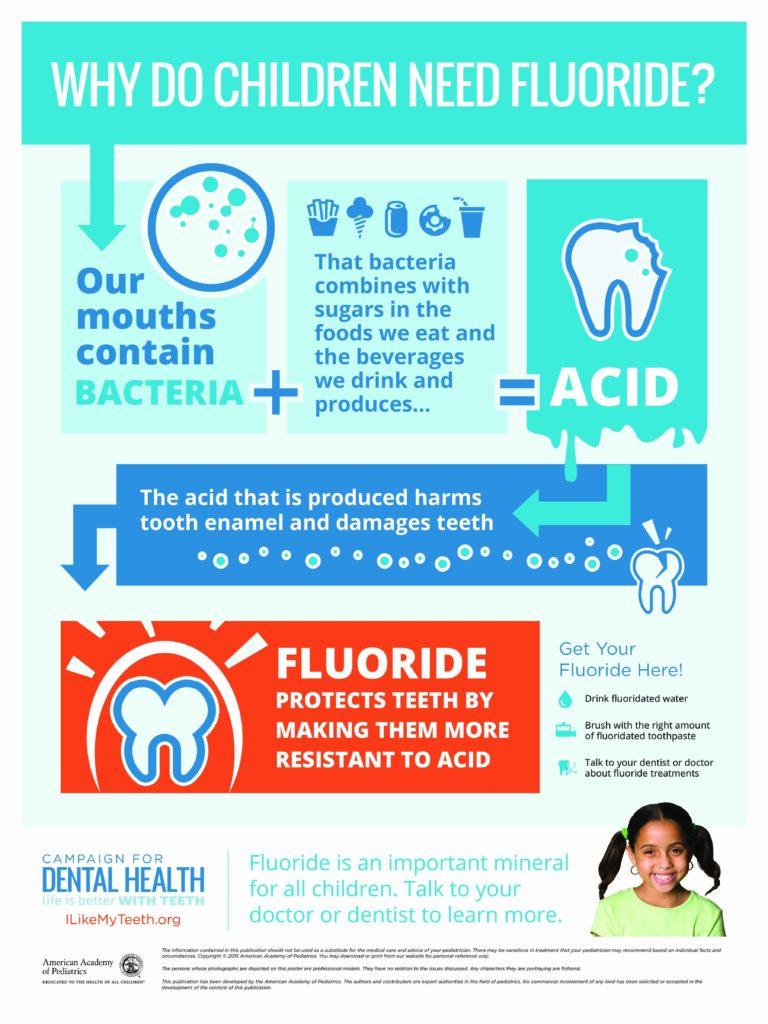
Why Children need fluoride?
Download
Water With Fluoride Builds A Foundation for Healthy Teeth
Download
Healthy Sips
Download
Sugar in drinks YouTube (Attach as QR code on poster)
View Video
All About Fluoride
Download
Fluoride Fast Facts
Download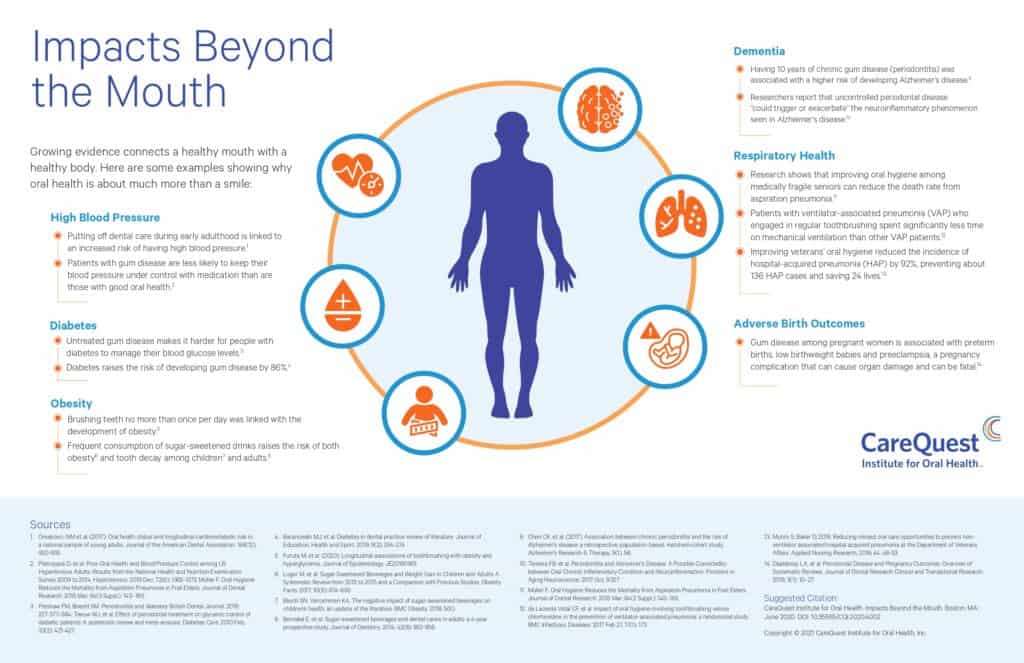
Impacts Beyond the Mouth
Download
Smile Hub
Visit Site
Visit PCOH to view more available resources and request free print materials
Visit Site
Best Practice Approach Improving Children’s Oral Health through the Whole School, Whole Community, Whole Child (WSCC) Model
Download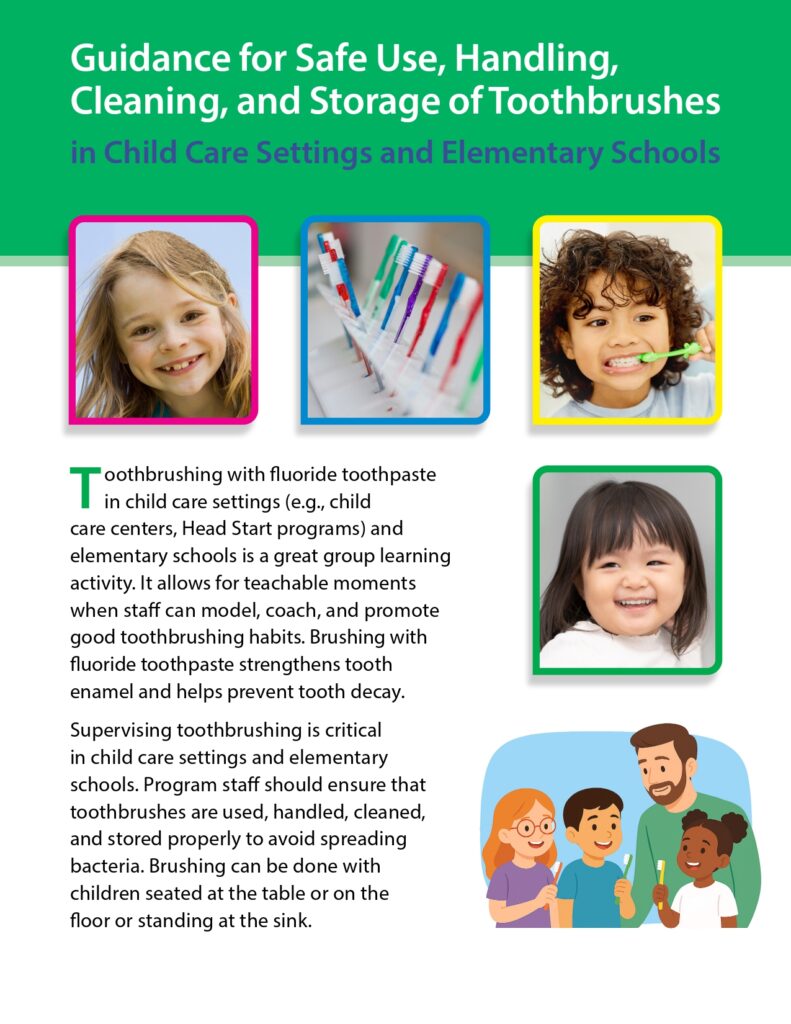
Guidance for Safe Use, Handling, Cleaning, and Storage of Toothbrushes in Child Care Settings and Elementary Schools
DownloadOral Health Education (Print or electronic – poster options available for select)
- Why Children Need Fluoride? (ilikemyteeth.org)
- Tooth tips for tweens and teens (AAP)
- How Fluoride Works
How to Fit Oral Health Into Your Schools
Keeping students and caregivers engaged in overall health is crucial. By taking these steps, you can empower students to prioritize overall health and provide them the opportunity to learn and understand health at a young age.
Here are some examples of what you can do throughout the school year.
- Start the conversations during health check-ups in the nurse’s office. You can learn a lot from these questions beyond their oral health.
-
- Have you seen a dentist in the last year?
-
- What have you been snacking on?
-
- Are you drinking water?
-
- Are you brushing your teeth every day?
- School digital outreach strategies such as social media, apps, portals, text messages, and newsletters: Insert any of the resources found in the toolkit to your school’s newsletter templates or social media posts. Send reminders to visit a dentist for routine check-ups.
- School-wide activities and student engagement.
- Below are some events you can incorporate at your school to foster student engagement and raise awareness. These events don’t need to focus solely on oral health, they can also highlight the connection between oral health and overall well-being. Create activities/newsletters/digital outreach based around these events. For instance, during Oral Cancer Awareness Month, activities could include anti-tobacco or nicotine campaigns, HPV education, and discussions about the oral health impacts of these factors. And National Nutrition Month, schools can emphasize the connection between nutrition and oral health.
-
- February is National Children’s Dental Health Month.
- March is National Nutrition Month – highlight how proper nutrition is related not only to overall health but preventing cavitie
-
- March 6th is National Dentist’s Day – this is a great opportunity to reach out to local providers to share school oral health needs and thank them for any support they can provide.
-
- March 20th is World Oral Health Day.
-
- April is Oral Cancer Awareness Month.
-
- 2nd week in April is Dental Hygienist Appreciation Week – another opportunity to bring oral health providers into your school and share oral health needs that they’ll be able to support the school with.
-
- National Smile Month (Mid May-Mid June)
- June 23rd is National Hydration Day – highlight the importance of drinking water vs sugary beverages. Great chance to show the importance related to overall health, including cavity prevention.
- August 6th is National Fresh Breath Day.
- November 1st National Brush Day.
Remember you can make these days any day of the year. These are just ideas to incorporate into your school year to promote and bring awareness to oral health. Refer back to resources to use around the school for these events.
Add Oral Health into the Curriculum

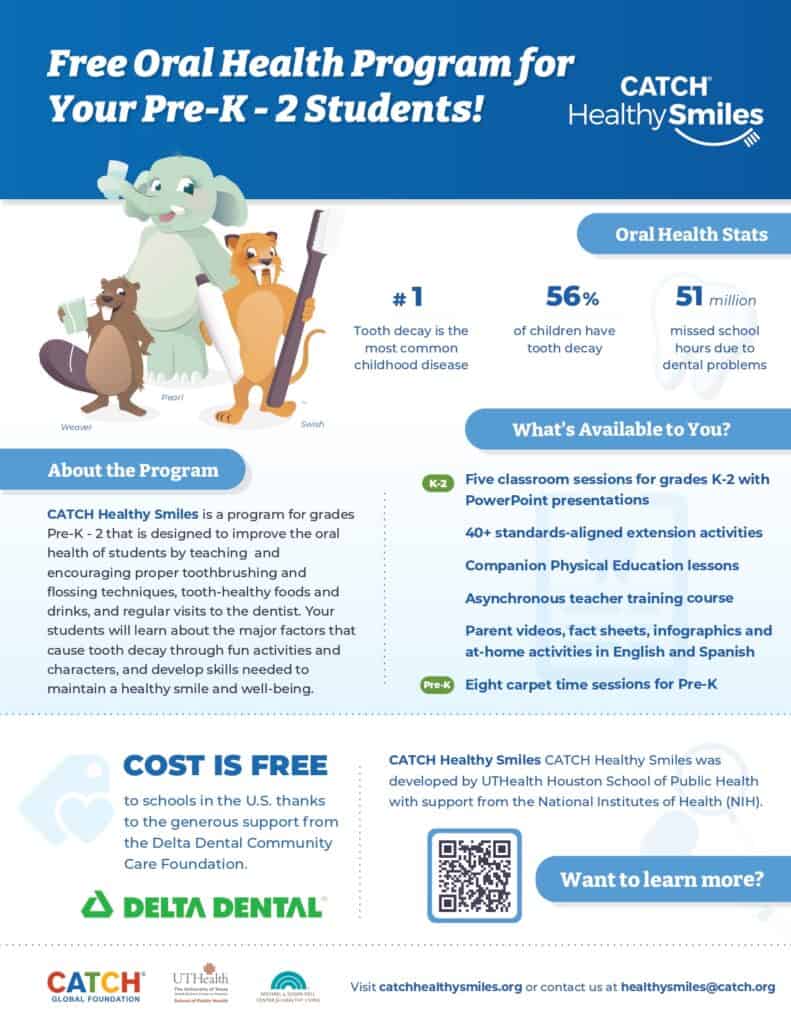
CATCH Healthy Smiles: A Free Oral Health Program for Schools
CATCH Healthy Smiles is a dynamic, no-cost oral health education program designed forPre-K through 2nd grade students. Sponsored by Delta Dental, this initiative helps schools integrate oral health into their curriculum while promoting lifelong habits that support both wellness and academic success.
CATCH Healthy Smiles is more than just a curriculum—it’s a comprehensive school-wide solution that includes:
|
Program Components
|
Description
|
|---|---|
|
Curriculum
|
Fun, standards-aligned lessons for Pre-K–2 that build oral health knowledge and skills
|
|
Teacher Training
|
Easy-to-access professional development to empower educators with confidence and clarity
|
|
Parent Outreach Materials
|
Ready-to-use resources to engage families and reinforce healthy habits at home
|
|
School-Wide Engagement Toolkit
|
Activities and ideas to create a culture of health across the entire campus
|
|
Health & Academic Standards Alignment
|
Fully aligned with national health and education standards to support learning goals
|
Schools that embrace CATCH Healthy Smiles understand that health is foundational to learning. When students feel well, they perform better—academically, socially, and emotionally. Communities that invest in student health see measurable improvements in:
- Attendance and focus
- Test scores and behavior
- Graduation rates and overall happiness
With everything provided for free, CATCH Healthy Smiles makes it easy for schools to champion oral health and set students up for success—inside and outside the classroom. You can also check out their other health programs!
Get the library involved
Here are some dental-related books to display throughout the year.

Brush, Brush, Brush
by Alicia Padron

Brush your teeth, Max and Millie
by Felicity Brooks

The Tooth Book
by Dr. Seuss and Joe Mathieu

Sugar Bugs
by Erica and Same Weisz

Celebrate! Going to the Dentist
by Sophia Day

Why should I brush my teeth?
by Katie Daynes

Sesame Street, Ready, Set, Brush
by Che Rudko

Brush Your Teeth, Please
by Jean Pidgeon

Open Wide: Tooth School Inside
by Laurie Keller

How to Catch the Tooth Fairy
by Adam Wallace

Sugarbug Doug: All About Cavities, Plaque, and Teeth
by Dr. Ben Magleby

The Last Loose Tooth
by Tyler Clark Burke

The Night Before the Dentist
by Natasha Wing
and Amy Wummer
and Amy Wummer

Melvin, the Magnificient Molar!
by Julia Cook, Laura Jana M.D.,
and Allison Valentine
and Allison Valentine

Daniel Goes to the Dentist
by Alexandra Cassel Schwartz
and Jason Fruchter
and Jason Fruchter
Free Toothbrushes and Toothpaste
Free Toothbrush and Toothpaste: Please share this link with your teachers for an amazing program Colgate runs each fall and spring for free toothbrushes, toothpaste, activities, and other resources.
Early Head Start Kit
*All Early Head Start materials will be available only digitally (effective Jan ’24) – please access them below.
*All items are in Spanish and English.
Head Start Kit
Kindergarten/1st Grade Kit
For Teachers
- Teacher’s Guide
- Accompanying storybook
- Classroom wall poster
(page 1, page 2)
For Students
- Colgate toothbrush & toothpaste
- Take home brushing chart
QR Codes
Easily direct parents to additional resources by including QR codes in your communications.


Educational Content for School Nurses
Together, we can support PA Oral Health Plan and Healthy People 2030 Oral Health Objectives while making a significant impact on the oral health of children in our community. Thank you for your dedication and commitment to their well-being!

Bright Futures Pocket Guide
Visit Site
Baby Teeth Eruption Chart
Download
Permanent Teeth Eruption Chart
DownloadParent/Caregiver Resource Center
Schools: Feel free to add this QR code to any documents to guide parents here to guide them to this section.

Welcome Parents!
Your children’s school is dedicated to ensuring not only their academic success but also their overall health and well-being. The Pennsylvania Chapter of the American Academy of Pediatrics (PA AAP) has developed this section specifically for you to address any oral health questions you may have.
Why Oral Health Matters
Oral health is a crucial part of your child’s overall health. Did you know that:
- Approximately 20% of children aged 5-11 years have at least one untreated cavity.
- Dental caries (cavities) is the most common chronic disease among children aged 6 to 19 years.
- Children with poor oral health are three times more likely to miss school due to dental pain.
By staying informed and proactive about your child’s oral health, you can help prevent these issues and ensure they maintain a healthy smile.
If you have any questions or need further assistance, please explore the resources provided here. We’re here to support you and your child’s journey to better oral health!
Prevention Works
Oral health prevention is effective because it helps avoid the onset of dental diseases and conditions, which can lead to significant health issues and economic costs. A significant portion of dental decay can be prevented with proper oral hygiene and preventive measures. Prevention involves a combination of professional care and self-care practices aimed at maintaining good oral hygiene and health.
A Guide to Packing a Healthy Lunch
Download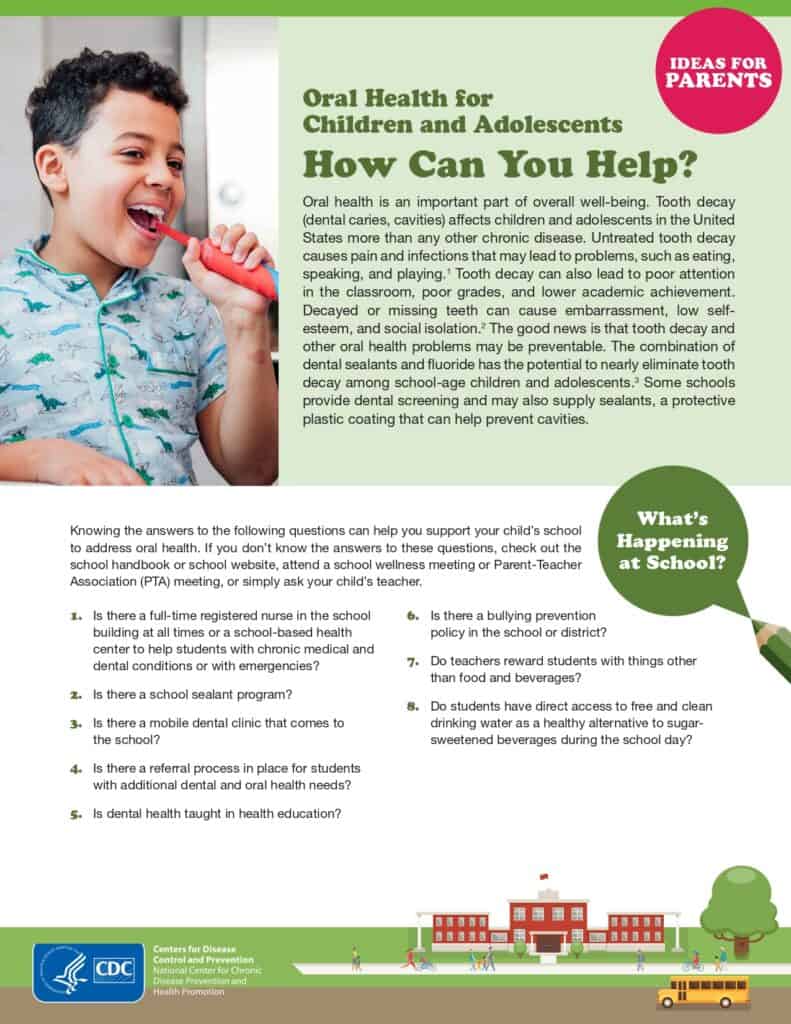
CDC: Ideas for Parents
DownloadHealthy Sips
Download
Healthy Habit All Stars: How to Brush
View Video
Healthy Habit All Stars: How to Floss
View Video
Healthy Habit All Stars: How to Prevent Cavities
View VideoFinding Dental Care (PCOH)
Visit SiteLocate Community Health Center (PACHC)
Visit Site
CATCH Parent Resources
Visit SiteFinding Dental Care
If you have insurance, please contact your insurance to guide you to offices in-network. You can also utilize these resources to help you locate a clinic if you do not have dental insurance and/or need assistance.
Finding Dental Care (Available in English and Spanish)
Use these websites to help begin to find a dental home
American Academy of Pediatric Dentists offers a valuable tool to help locate a pediatric dentist within your community. Please encourage caregivers contact child’s insurance to guide them to offices in-network or participating providers. Schools can also use this tool to locate local dentists in the school district to network for dental health events and working together to help with any oral health needs.
Dental and Dental Hygiene Programs in Pennsylvania provide dental services at a low or reduced cost to anyone. There are 13 dental hygiene programs and 4 dental programs.
Federally Qualified Health Centers (FQHCs) are primary care facilities in rural and urban areas. There are more than 120 FQHC sites in PA that provide dental care. All insurances are accepted. Fees are based on what the patient can pay and are often based on income level and family size. To locate an FQHC, visit my.pachc.org/Find-a-Health-Center.
Managed Care Organizations (MCOs) can connect their members with dental providers in their regions. For the member services phone numbers for each managed care organization, visit dhs.pa.gov/providers/Providers/Pages/Statewide-Managed-Care-Map.aspx. For provider lists by health plan, visit enrollnow.net.
Rural Health Clinics are focused on providing primary care services in non-urbanized areas. Availability of dental services will vary by location. For more information, visit www.porh.psu.edu
Making a list of local Medicaid-accepting pediatric dentists. You can use resources like https://www.insurekidsnow.gov/find-a-dentist to locate Medicaid providers and dental clinics.
Pennsylvania Coalition for Oral Health offers these options as well as many others to help aid in finding dental care. The Finding Dental Care resource is available in English and Spanish.
Fluoride
Community Water Fluoridation
Fluoride is a key player in the fight against tooth decay, and understanding its presence in your local water supply can help you make informed decisions about your family’s oral health. In Pennsylvania, as well as in many other states, community water systems that choose to fluoridate their water operate under strict guidelines to ensure safety and effectiveness. The Centers for Disease Control and Prevention (CDC) has identified an optimal fluoride concentration of 0.7 milligrams per liter (mg/L) in drinking water as the ideal level to prevent cavities while minimizing the risk of dental fluorosis, a condition caused by excessive fluoride intake during tooth development.
In Pennsylvania, the Department of Environmental Protection oversees water fluoridation practices by issuing permits to community water systems. These systems are required to adhere to the optimal fluoride levels, carefully monitoring and adjusting concentrations to maintain compliance. This regulatory oversight ensures that residents have access to safe and effective fluoridated water.
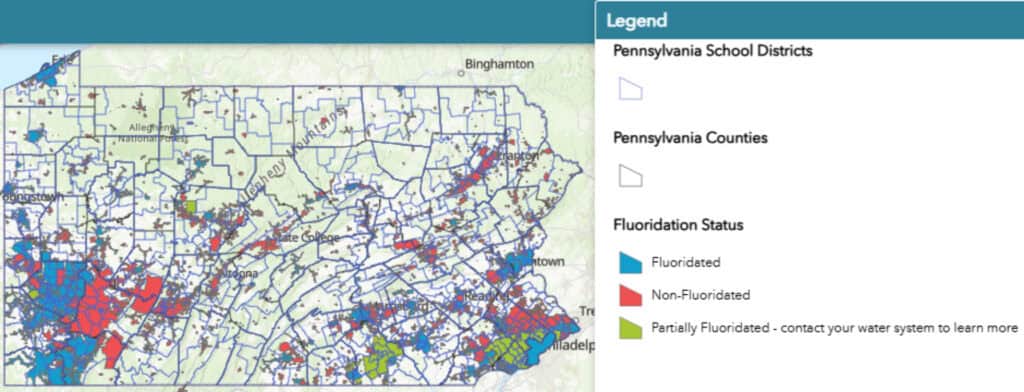
For parents/caregivers, this information is especially valuable because fluoride in water strengthens tooth enamel, helps repair early signs of decay, and provides a cost-effective method of improving dental health for entire communities. Fluoridated water reaches everyone, including those who might not have regular access to dental care. To check if you live in a community with fluoridated water, visit Community Water Fluoridation Status in Pennsylvania or My water’s fluoride through the CDC to learn more. This map, broken down by school district and county, shows one way this resource reflects the availability of water fluoridation.


Topical Fluoride Varnish
Topical Fluoride Varnish FAQs for Parents
In case you had concerns, here are some frequently asked questions and answers to clear things up.
What is Fluoride Varnish?
Fluoride varnish is a protective coating that is applied to teeth to help prevent cavities. Fluoride varnish is made with fluoride, a naturally occuring mineral that can be found in many foods and water and strengthens tooth enamel (outer coating on teeth).
Why is Fluoride Varnish recommended?
Cavities can cause pain and infections, which can lead to problems eating, speaking, playing, and learning. Fluoride varnish makes teeth stronger, stops cavities from getting worse and helps prevent new cavities from forming.
Is Fluoride Varnish safe?
Yes, fluoride varnish is safe to apply at any age. Only a small amount is used, and hardly any fluoride is swallowed. It is quickly applied and hardens.
How is Fluoride Varnish applied?
Fluoride varnish is painted on teeth with a brush. The process is quick and easy and does not cause pain. The varnish sticks to the teeth and may leave a thin, temporary coating. This is normal and will go away when teeth are brushed.
How long does Fluoride Varnish last?
Fluoride varnish protects teeth for several months. It works best when reapplied every three to six months.
Can my child eat or drink after application?
Eating and drinking after application is ok. If possible avoid hot, hard or sticky foods for 4-6 hours.
Feel free to contact your school nurse, or medical or dental provider for further oral health questions.
Implementing a Topical Fluoride Varnish (TFV) Program
Pennsylvania Chapter, American Academy of Pediatrics has added this section of the toolkit to help support implementing a fluoride varnish program for your school. These programs are aimed at improving the oral health of our students. This evidence-based program offers numerous benefits that can significantly impact the well-being and academic success of our children.
Why Implement a Fluoride Varnish Program?
- Prevention of Tooth Decay: Fluoride varnish is a proven method to prevent dental caries (tooth decay). By applying a small amount of fluoride varnish to the teeth, we can strengthen the enamel and make it more resistant to acid attacks from bacteria, thereby reducing the incidence of cavities.
- Promoting Health Equity: This program is especially beneficial for children from low-income families who may have limited access to dental care. By providing preventive dental care at school, we can help bridge the gap and ensure all students have the opportunity to maintain good oral health.
- Cost-Effective Solution: Preventive care is far more cost-effective than treating dental problems after they occur. By reducing the need for more extensive dental treatments, we can save families and the healthcare system significant costs.
- Enhancing Overall Health: Good oral health is closely linked to overall health. Preventing dental issues can reduce the risk of other health problems, such as infections and chronic diseases, contributing to the overall well-being of our students.
- Supporting Academic Success: Healthy children are better learners. By preventing dental problems, we can help ensure that students miss fewer school days due to dental pain or treatment and can focus better on their studies.
- Community Engagement: Implementing this program in our schools fosters community engagement and raises awareness about the importance of oral health. It provides an opportunity for parents, teachers, and healthcare providers to work together towards a common goal.
Steps to Implement a Topical Fluoride Varnish Program
Promoting oral health in children through the application of topical fluoride varnish is an essential preventive measure. Schools can play a vital role in reducing the incidence of dental caries by initiating such programs. Here are the steps to get started:
Step 1: Determine Fluoridation Status of Your Community
Understanding the fluoride level in the local water supply is the first step. According to CDC, community water systems in Pennsylvania that fluoridate their water must do so under a permit issued by the Department of Health, maintaining an optimal fluoride level of 0.7 mg/L to prevent tooth decay.
To check if your school district has access to fluoridated water, visit Community Water Fluoridation Status in Pennsylvania, which has several features to learn more about the status of water fluoridation in your community. This map, from Pitt’s Community Water Fluoridation Status in Pennsylvania interactive map resource, is broken down by school district and county, shows one way this resource reflects the availability of water fluoridation.
Studies by the U.S. Public Health Services highlight that quarterly applications of topical fluoride are highly beneficial for children in non-fluoridated areas. Schools in such areas can adopt the Topical Fluoride Program.
Step 2: Review SHARRS Information for Program Implementation
To ensure the program is effective, the following steps should be undertaken:
- Confirm the fluoride levels in the water currently being consumed.
- The program should begin at age 3 and continue through at least grade 7, as the benefits of topical fluoride extend into adulthood.
- Inform and educate parents of eligible children about the program and secure written parental permission, which should be stored with each pupil’s dental record.
- A standing order for topical fluoride varnish can be issued by the School Dentist and must be updated if a new dentist is appointed.
- The School District should assign a qualified individual to apply the fluoride varnish. Please see below for oral health in your school for training on topical fluoride varnish.
Step 3: Collecting Data
To monitor and refine the program, schools should consistently collect and review data related to its implementation and outcomes. This data will help in assessing the program’s impact and ensuring it meets its goals effectively. According to SHARRS, the school dental health record (H514.025) also documents individual pupil participation in the fluoride program. Summary data for pupil participation in fluoride preventive programs is provided to the school nurse or school hygienist at the end of each school year. This data is included in the annual “Request for Reimbursement and Report of School Health Services”.

Oral Health in Your School
The School-Based Oral Health Initiative, developed by the Pennsylvania Chapter of the American Academy of Pediatrics (PA AAP), is a comprehensive training program that equips school nurses with the knowledge and skills to integrate preventive oral health services into their daily practice. This course covers essential topics including dental caries prevention, fluoride varnish application, and oral health education delivery. Participants will learn to implement evidence-based preventive care strategies, effectively communicate with stakeholders, and navigate necessary documentation requirements. The program emphasizes practical implementation within school settings while addressing health equity through accessible preventive care. Upon completion, school nurses will be prepared to enhance their school’s dental health program with preventive services that can significantly impact student oral health outcomes.
Documents for Implementation
Here are resources to help support initiating a TFV program.

Guidelines for the School Dental Health Program for Pennsylvania's School Age Children and Adolescents
Download
What is fluoride?
Download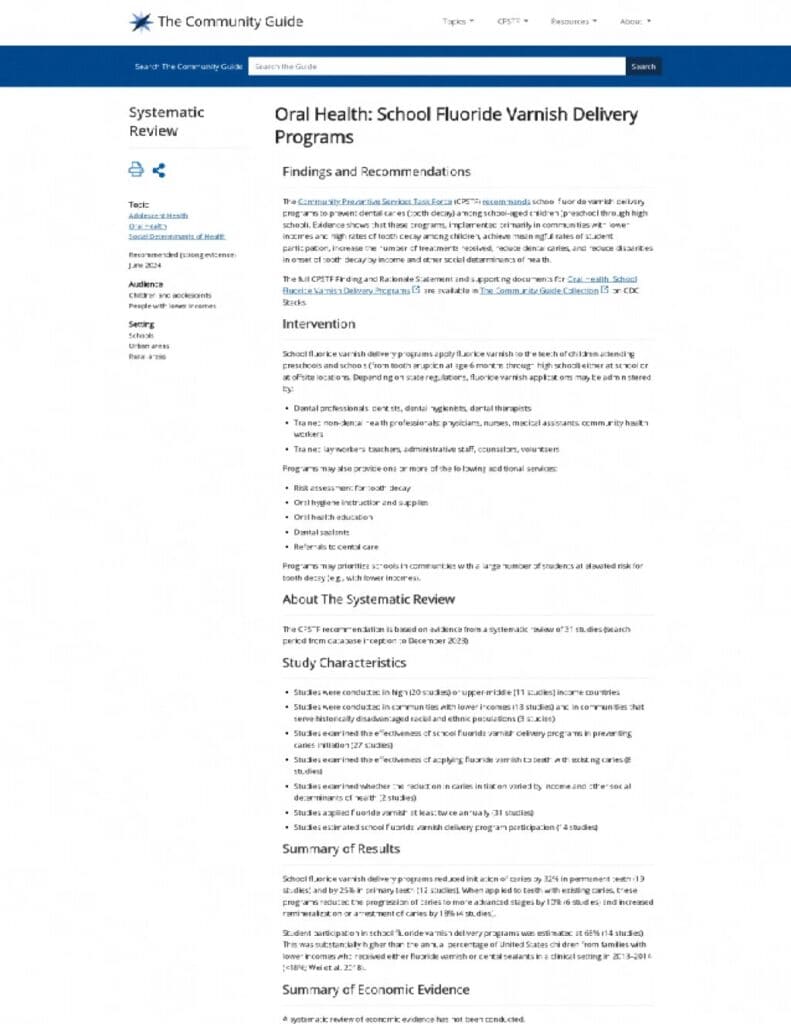
Oral Health: School Fluoride Varnish Delivery Programs – Systematic Review
Visit Site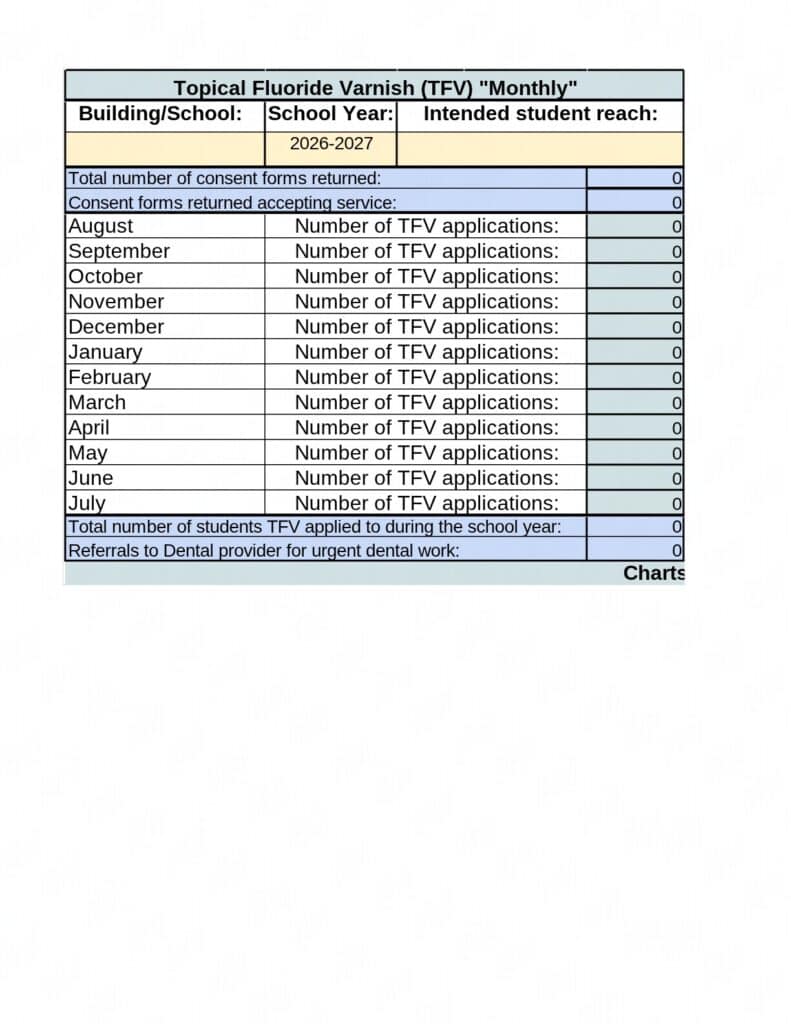
Student Tracking Sheet
Download


Walk through on how to document SHARRS
SHARRS Documentation
School nurses should be reporting their fluoride information from the current school year during the SHARRS Reporting window.
*For example, 2024-2025 school year reporting window runs from May 2025 – September 2025.
There are two areas of the SHARRS report that are applicable to fluoride programs:
- Itemized Expenditures:


- Mandated Dental Services Program
- Daily reporting sheet
Suggest Models
How to fit into school year

Quick Guide
View the Quick Guide
Quick Guide
- Introduction to Topical Fluoride Varnish
Overview: What is fluoride varnish and its benefits?
Evidence-Based Practices: Research supporting its use in preventing dental caries.
- Application Guidelines
Step-by-Step Instructions: Detailed guide on how to apply fluoride varnish.
Safety Measures: Proper handling, storage, and disposal of materials.
Video Demonstrations: Visual aids to complement written instructions.
- Consents
Superintendent/Principal Approval: Letter explaining program and benefits of fluoride varnish
Physician of record and Dentist of record approval: Letter explaining program and confirming necessary documentation is completed (signing off on running order for fluoride)
Parent Consent Form Template: A sample form that includes necessary information (child’s name, date of birth, parent/guardian contact information, etc.).
Instructions for Parents: Clear explanation of what fluoride varnish is, its benefits, and any potential side effects.
Distribution Plan: How to distribute and collect consent forms from parents.
- Incorporating into Daily Tasks
Integration with School Routine: How to incorporate fluoride varnish application into the school day without disrupting classes.
- Record Keeping
Documentation Templates: Forms for recording each application (date, time, nurse’s name, etc.).
SHARRS: How to use SHARRS to maintain records.
- Training and Resources
Training and workshops: Opportunities for school nurses to receive hands-on training and support.
Reference Materials: Handouts, guides, and quick-reference resources.
Support Network: Contact information for dental professionals, oral health organizations, dental/dental hygiene programs, and support resources.
- Evaluation and Feedback
Monitoring and Assessment: Methods to evaluate the effectiveness of the fluoride varnish program.
Feedback Mechanism: How to gather feedback from parents, students, and staff to improve the program.
Organizations and valuable websites
Resources

Oral Health Professional Resources
DownloadReferences
- CareQuest Institute for Oral Health
- U.S. Centers for Disease Control and Prevention Oral Health
- Colgate
- Smiles for Life
- Association of State & Territorial Dental Directors
- American Journal of Orthodontics & Dentofacial Orthopedics
- Oral Health Progress and Equity Network
- From the First Tooth
- Journal of The American Dental Association
- Pennsylvania School Health Guidelines
- American Dental Association – Fluoride Facts
- Bright Futures: Oral Health—Pocket Guide, 3rd edition
- Pennsylvania Coalition for Oral Health Resources
Valuable Websites to Visit
- Pennsylvania School Health Guidelines
- CareQuest Institute for Oral Health
- Pennsylvania Chapter, American Academy of Pediatrics: Oral health and resources
- Healthy Teeth, Healthy Children
- Pennsylvania Coalition for Oral Health
- Pennsylvania Office of Rural Health
- Pennsylvania Office of Community Health Centers
- National Maternal and Child Oral Health Resource Center
- Bright Futures: Oral Health—Pocket Guide, 3rd edition
- Smiles for Life
- From the First Tooth
- American Dental Association
- School-Based Health Alliance
- National School Nurse Association – Oral Health Connections
- Pennsylvania Association of School Nurses and Pracitioners
- CDC Healthy Schools
- Oral Health Learning Cafe
- Missouri Department of Health and Senior Services Office of Dental Health: Oral Health Guide for Caregivers of School-Aged Children – Dental First Aid
- Whole School, Whole Community, Whole Child (WSCC)